Safety
222nm Far-UVC is safe
Traditionally UV light is seen as harmful, and for the common 254nm lamps it is. 222nm is different. More than ten years of studies on skin, on eyes and on people exposed every day at work have found no skin cancer, no damage to living skin cells and no damage to the cornea, at doses far above anything used for sanitising. The regulators have reached the same view. In 2022 the ACGIH, whose exposure limits are used across occupational health, raised its limit for 222nm sevenfold for the eye and twentyfold for the skin on the strength of that evidence.
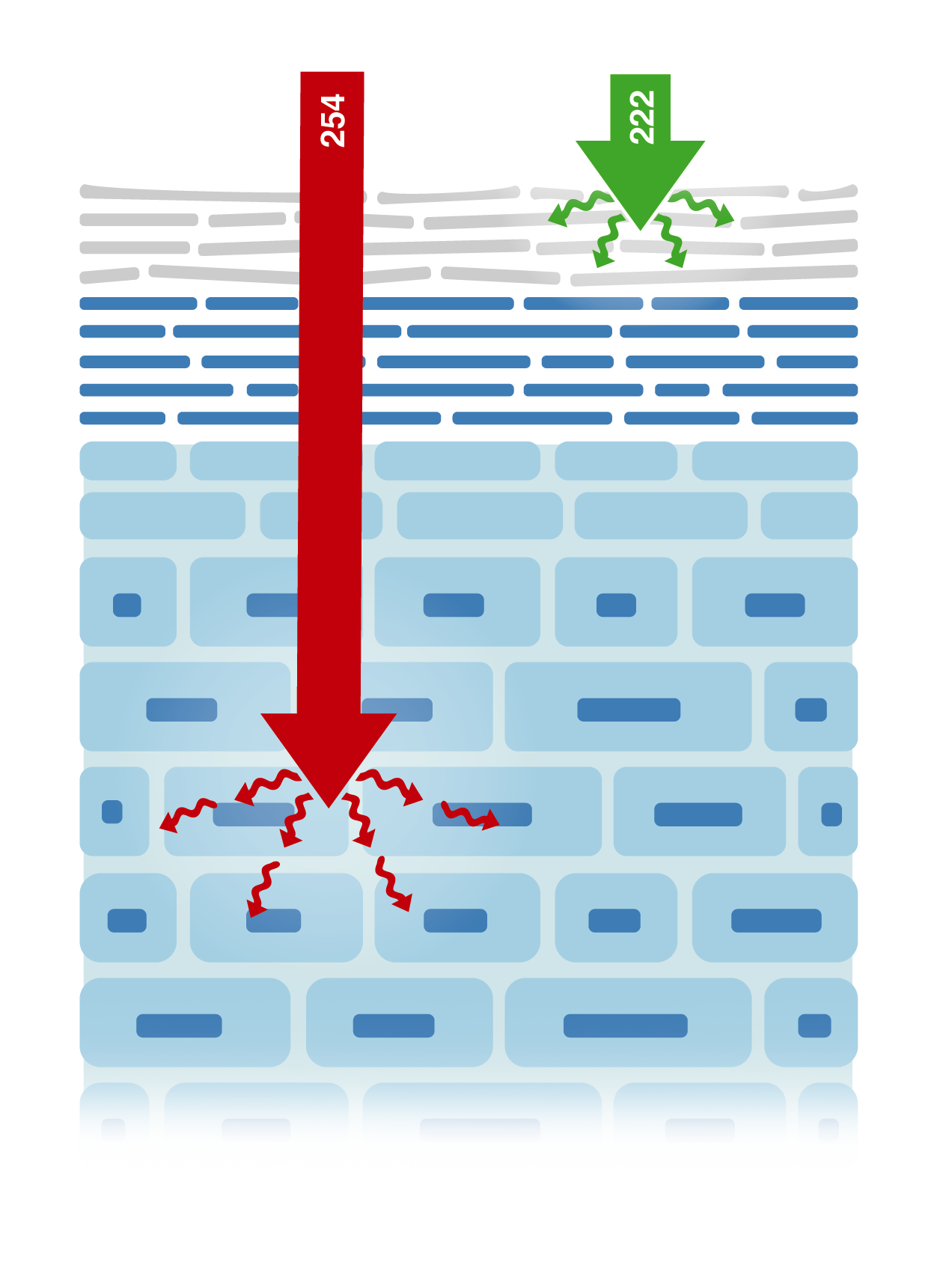
Doesn't penetrate skin
222nm light is absorbed very strongly by protein. The outer layer of your skin is made of dead, protein-packed cells, and the light is used up in the first few thousandths of a millimetre. It never reaches the living cells underneath where UV damage and skin cancers start.
In 2020 a Japanese team exposed mice bred to be ten thousand times more prone to UV skin cancer than normal to 222nm light three times a week for ten weeks. No cancers, no inflammation, no DNA damage. In 2023 the Columbia group exposed mice daily for 66 weeks, most of a mouse's life, at doses above the European limit. No skin cancer and no other skin changes. In a 2020 trial on healthy volunteers, 500 mJ/cm² on the skin, more than a hundred times what you would get under our unit in an hour, killed bacteria on the skin and left the skin unharmed.
Safe for eyes
Less than 0.001% of 222nm light gets through the tear film of the eye. In a 2019 study, rats exposed to 222nm at up to 600 mJ/cm² showed no damage to the cornea; 254nm caused clear damage at the same doses. A 2023 study followed workers in a room lit with 222nm lamps for a year and found no effect on their eyes or eyelids. A further study in 2025 found no eye damage or loss of vision in mice exposed for the long term.
The exposure limits
The limits say how much 222nm light a person may receive in a working day.
ICNIRP, used in the UK and Europe: 23 mJ/cm² per 8 hour day, which works out at about 3 mJ/cm² an hour.
ACGIH 2022, used in the United States: 161 mJ/cm² per day for the eye and 479 mJ/cm² for the skin. Before 2022 both were 23.
The ProTech 2 is set up so that people in the room receive no more than about 3 mJ/cm² an hour, which keeps a full day inside the European limit and well inside the American ones. The doses that inactivate airborne virus in the studies, one to three mJ/cm², are a fraction of these limits.
Safety by design
The wavelength is only half of it. A filtered lamp, a managed dose and a proper installation are the other half.
The lamp is filtered to remove the longer wavelengths a bare krypton chloride lamp gives off. Motion and LiDAR sensors tell the unit whether the room is occupied and hold the dose inside the limits when it is. Every unit logs the dose it has delivered, so you can show an inspector or an insurer exactly what a room has had. And units are placed and set according to a plan for the room, not simply switched on. The ozone emitted by the unit is minimal and is not a safety issue.
The studies
Buonanno et al., 2017, Radiation Research. Skin model and mice; 222nm versus 254nm at the same dose.
Narita et al., 2018, PLoS One. Chronic 222nm exposure, no DNA damage in mouse skin.
Kaidzu et al., 2019, Free Radical Research. Cornea, 222nm versus 254nm.
Yamano et al., 2020, Photochemistry and Photobiology. Cancer-prone mice, ten weeks.
Fukui et al., 2020, PLoS One. Healthy volunteers, 500 mJ/cm².
Welch et al., 2023, Photochemistry and Photobiology. 66 weeks of daily exposure.
Sugihara et al., 2023, Photochemistry and Photobiology. A year of workers under 222nm lamps.
Arden et al., 2025, Current Eye Research. Long term eye exposure.
Please contact us for the full safety and efficacy review, which digests the published literature on 222nm Far-UVC.

Compliant with standards and certification
The Frido ProTech 2 is CE and UKCA certified.