
Offices & Meeting rooms
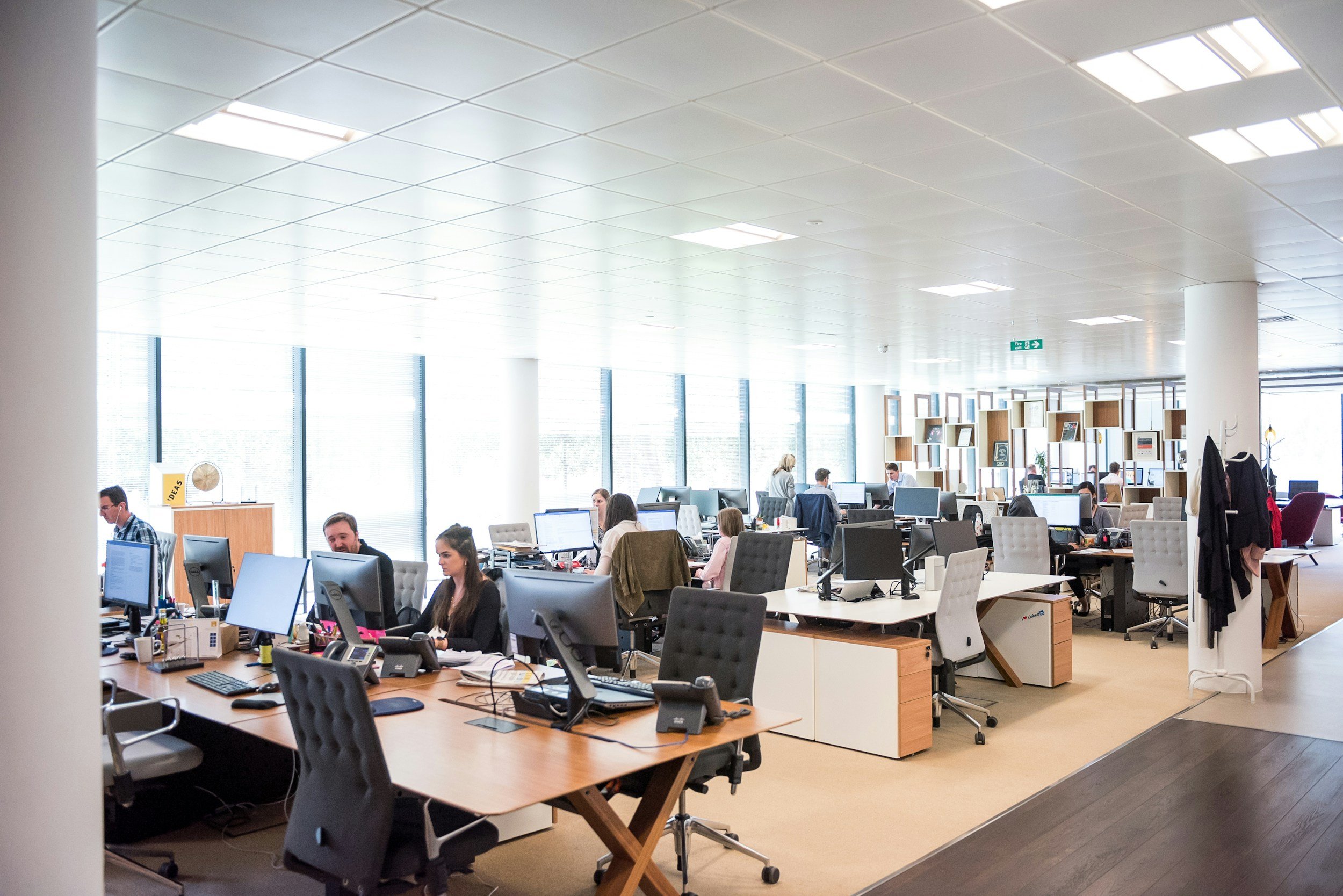
How to reduce people getting sick in your office
An office catches things in its small rooms. Eight people, a closed door, an hour, and whatever one of them brought in on the train that morning. Open plan floors have volume and movement on their side; meeting rooms, huddle rooms, the kitchen and the lift do not. They are the rooms with the most people per cubic metre and the least air, and they are where the winter cold and flu do the rounds and where, a few days later, half a team is off.
A 222nm ceiling unit runs in those rooms whilst they are in use, bringing down the germs in the air and on the table continuously, silently and invisibly, inside the occupational exposure limits. In March 2026 Endeavour Management fitted the ProTech 2 in the meeting rooms of its building near the Tower of London.
What sickness costs an office
UK workers lost around 150 million working days to sickness in 2023, and minor illness, coughs, colds and flu, is the single most common reason. [Check the current ONS release.] The CIPD put the average at 7.8 days per employee a year in its 2023 survey, the highest in a decade. [Check.] For a firm of fifty people on average London salaries that is several hundred thousand pounds of paid absence a year, before cover, lost output and the client meeting that happened without the person who knew the account. Presenteeism, people coming in unwell and infecting the room, costs more again and is harder to count.
Why the usual answers fall short
Ventilation is the first answer and in most buildings it is fixed. The system was sized for the floor when it was fitted, the meeting rooms were added or subdivided afterwards, and the facilities manager cannot buy more air. Opening a window is not an option on the fourteenth floor. Portable filters are noisy in a small room and only treat the air that passes through them. Wipes and sprays deal with the table at the end of the day, not the air during the meeting. Sending people home when they are ill works, up to the point where they are infectious before they feel it.
What Far-UVC does in a room
A 222nm unit lights the air and the surfaces of the room whilst people are in it, at a dose the exposure limits allow for a full working day.
In 2024 Columbia University put four 222nm ceiling fixtures in a room where staff worked all day and measured a 99.8% drop in airborne norovirus. In a busy dental clinic that already had ten air changes an hour, 222nm cut airborne bacteria by about 80%, worth another six and a half air changes; a meeting room on the building's standard supply gains proportionally more. Airborne coronavirus is reduced by about 90% in eight minutes at the occupied-room dose and 99.9% in twenty five, and airborne flu by more than 95% at a dose of 2 mJ/cm². In a Japanese study, 222nm lamps ran in an office for a year with workers underneath them; their eyes were unaffected and the room's microbial load was reduced throughout. A 2025 study found that 222nm also damages the proteins in common airborne allergens, which is of some interest to anyone who runs an office with carpets. The studies.
Where the units go
Meeting rooms first. They are the worst rooms in the building for infection and the cheapest to protect: one unit covers about 20 square metres under a 3m ceiling, so most meeting rooms take one, a boardroom two or three.
Then the kitchen and the break-out areas, where people cluster round the coffee machine.
Then the lift lobbies and the reception, where everyone passes through.
Then the open plan floor, if the budget runs to it, concentrating on the densest banks of desks.
What it does for the business
Fewer sick days, and fewer of the clustered sick days that take out a whole team in the same week.
Fewer clients and visitors catching something in your meeting room.
A building that can say what it is doing about air quality.
No chemicals, no noise, no filters, nothing for the cleaners to handle. About 20W a unit.
Cost
About 20W a unit, less when the room is empty, and a lamp every two to three years. Price for the unit depends on volume- contact us for more information. they are fitted by your electrician or the landlord's contractor; we supply the plan, commission the units and check them remotely.
FAQ
Is it safe to sit under all day?
Yes. 222nm cannot get past the outer layer of skin or the tear film of the eye. Workers under 222nm lamps for a year showed no effect on their eyes, and the unit holds a full working day inside the published limits. Read more about Safety.
Will anyone notice it?
The light itself is invisible and silent. The unit looks like a ceiling fitting with a small status light which reassures people that it is operating. It is up to the operator to decide how much they want to publicise the additional protection that they are offering their staff.
Does it replace the ventilation?
It adds to it. It is worth six and a half extra air changes an hour in a room that already had ten; a meeting room on a standard office supply gets a bigger proportional benefit.
How many do we need?
One per meeting room up to about 20 square metres, two or three for a boardroom, then the kitchen, lobby and reception. We produce a plan from your floor plan.
Can the landlord object?
It is a ceiling fitting with a mains connection, CE and UKCA certified, fitted like a downlight. Most leases treat it as a tenant fit-out item.
What happens when the room is empty?
The motion sensor rests the lamp, which extends its life.
Does it help with hay fever and dust allergies?
A 2025 study found that 222nm changes the proteins in common airborne allergens so the immune system recognises them less. It is early evidence and we do not sell the unit for that, but it is a pleasant side effect.
The studies
Buonanno M, Kleiman NJ, Welch D, et al. 222 nm far-UVC light markedly reduces the level of infectious airborne virus in an occupied room. Scientific Reports, 2024. doi.org/10.1038/s41598-024-57441-z
Welch D, Buonanno M, Tang Z, et al. 222 nm far-UVC to inactivate airborne bacteria in an occupied dental clinic. Journal of Hospital Infection, 2025. doi.org/10.1016/j.jhin.2025.11.015
Buonanno M, Welch D, Shuryak I, Brenner DJ. Far-UVC light (222 nm) efficiently and safely inactivates airborne human coronaviruses. Scientific Reports, 2020. doi.org/10.1038/s41598-020-67211-2
Welch D, Buonanno M, Grilj V, et al. Far-UVC light: a new tool to control the spread of airborne-mediated microbial diseases. Scientific Reports, 2018. doi.org/10.1038/s41598-018-21058-w
Eadie E, Hiwar W, Fletcher L, et al. Far-UVC (222 nm) efficiently inactivates an airborne pathogen in a room-sized chamber. Scientific Reports, 2022. doi.org/10.1038/s41598-022-08462-z
Sugihara K, Kaidzu S, Sasaki M, et al. One-year ocular safety observation of workers and estimations of microorganism inactivation efficacy in the room irradiated with 222-nm far ultraviolet-C lamps. Photochemistry and Photobiology, 2023. doi.org/10.1111/php.13710
Eidem TM, Rugh KM, Hernandez MT. Far UV exposure (UV222) decreases immune-based recognition of common airborne allergens. ACS ES&T Air, 2025.
Welch D, Kleiman NJ, Arden PC, et al. No evidence of induced skin cancer or other skin abnormalities after long-term (66 week) chronic exposure to 222-nm far-UVC radiation. Photochemistry and Photobiology, 2023. doi.org/10.1111/php.13656
Kristensen MA, Mogensen EH, Nielsen SY, Holm CK. The potential effectiveness of far-UVC (222 nm) in preventing infections in long-term care facilities: a six-month nonrandomized controlled phase II trial. Antimicrobial Stewardship & Healthcare Epidemiology, 2026. doi.org/10.1017/ash.2026.10425
Office for National Statistics. Sickness absence in the UK labour market.
CIPD. Health and wellbeing at work survey, 2023. [Check the 7.8 days figure against the current survey.]
ACGIH. Threshold limit values for ultraviolet radiation, 2022 edition, 222 nm limits of 161 mJ/cm² (eye) and 479 mJ/cm² (skin) per 8 hours.
Updated: October 2026