
Cruise ships
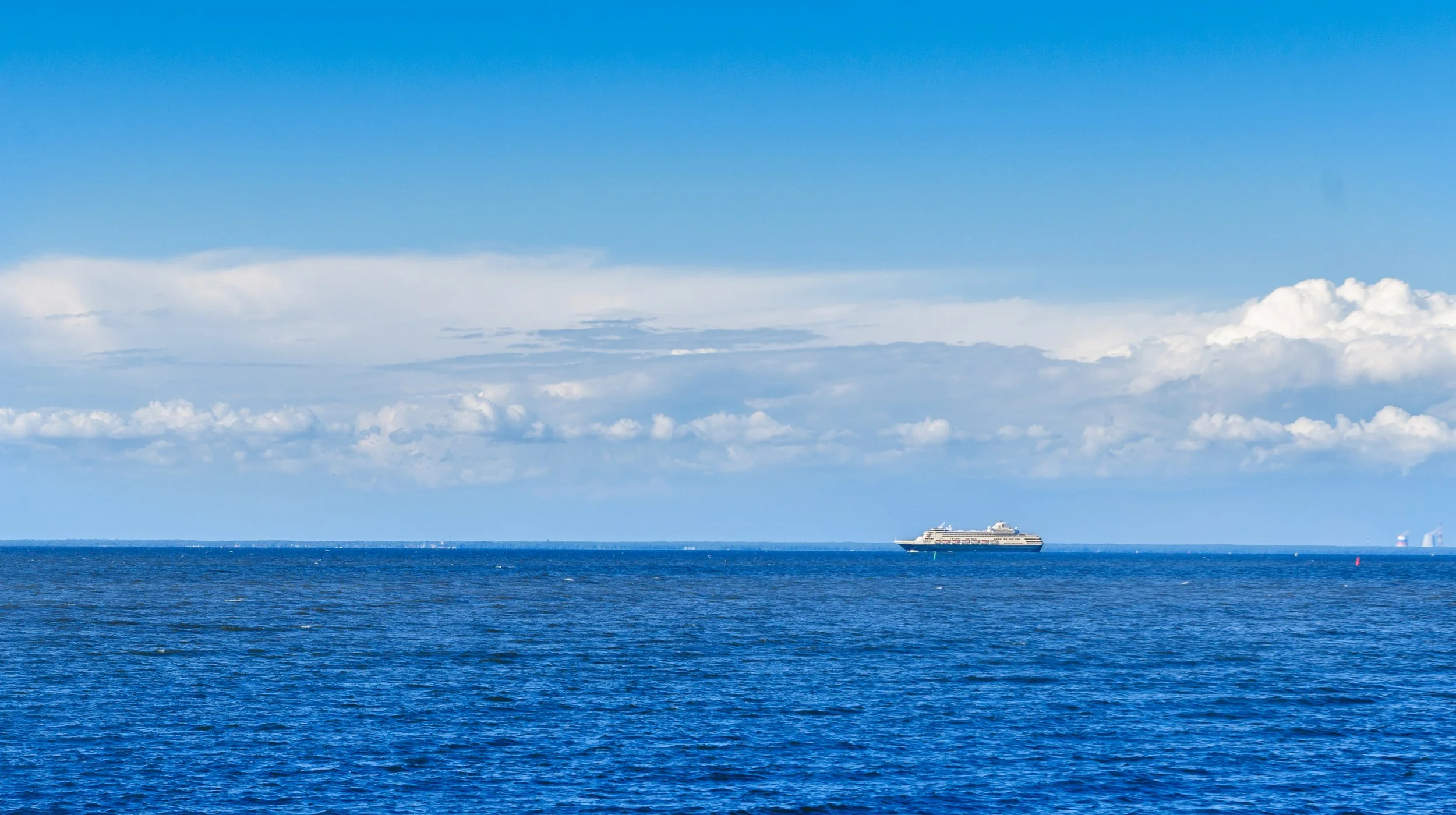
How to stop illness spreading on a cruise ship
Illness spreads on a cruise ship through the air and surfaces of the spaces where passengers and crew gather: restaurants, buffets, bars, theatres, gyms, spas, lifts and the crew mess. The established controls, hand-washing stations, food safety, isolation of sick guests and enhanced cleaning, reduce transmission but only reset the ship between contacts. Far-UVC adds a layer that the others cannot: continuous inactivation of airborne and surface pathogens in occupied rooms, every hour the room is in use. The Frido ProTech 2 is a ceiling-recessed 222 nm unit designed for ship interiors and installed on three ocean cruise ships; a full-ship fit-out of the high-footfall public spaces takes around 300 units.
Why ships are hard to protect
Closed population, high contact rate. Several thousand people share the same dining rooms, lifts and corridors for a week or more. Norovirus has been the leading cause of gastroenteritis outbreaks on cruise ships since 2006; in a systematic review of 45 outbreaks on 26 ships, person-to-person transmission was involved in 35 of them and the average passenger attack rate was 7% (Mouchtouri et al., 2024).
Outbreaks are frequent and public. The US CDC's Vessel Sanitation Program recorded 14 gastrointestinal outbreaks on ships in its jurisdiction in 2023, 18 in 2024, and 16 by mid-2025. Cruise ship sickness outbreaks tend to be reported often and capture the public’s imagination.
Low ceilings and recirculated air. Ship interiors have ceiling heights that rule out upper-room UVGI and HVAC systems that are already at their design limit, so "add more ventilation" is rarely available.
Respiratory illness too. Influenza and COVID outbreaks disrupt cruises as badly as norovirus does and spread through the same spaces; the aerosol route matters for norovirus as well, because vomiting releases virus into the air.
Crew. Sick crew cannot be replaced mid-voyage; a galley or housekeeping team losing a third of its staff degrades service across the whole ship.
What a far-UVC layer does on board
Ceiling-mounted 222 nm units irradiate the air and the exposed surfaces of a room while it is occupied, within the human exposure limits. The effect is continuous and independent of the HVAC system. There is more information on the evidence page
| Evidence | Result | Relevance to a ship |
|---|---|---|
| Four ceiling 222 nm fixtures in an occupied working room (Buonanno et al., 2024) | 99.8% reduction in infectious airborne norovirus, within regulatory limits | Directly applicable to buffets, restaurants and crew mess |
| Occupied dental clinic (Welch et al., 2025) | About 80% reduction in airborne bacteria, equivalent to an extra 6.5 air changes per hour on top of 10 ACH ventilation | A typical ship dining room at 2–3 ACH gains proportionally more |
| Aerosolised coronavirus at the occupied-room dose rate (Buonanno et al., 2020) | 90% inactivated in 8 minutes, 99.9% in 25 minutes | Covers the respiratory outbreaks that also stop ships |
| SARS-CoV-2 on a surface (Kitagawa et al., 2020) | 99.7% in 30 seconds at laboratory irradiance | Handrails, tables and buffet surfaces between cleans |
Where the units go
A Frido placement plan prioritises the spaces by occupancy-hours and contact rate. For a mid-sized ship the fit-out of around 300 units typically covers:
Buffet and main dining rooms, including serving lines and the queue areas outside them
Speciality restaurants, bars and lounges
Theatre, atrium and other congregation areas
Gym, spa, treatment rooms and changing rooms
Medical centre, including the waiting area and isolation cabins
Crew mess, crew bar and crew recreation spaces
Lift lobbies and the main stair landings
How it fits with the Vessel Sanitation Program and your Outbreak Prevention and Response Plan
Far-UVC does not replace any VSP requirement. Hand-washing stations, food-handler health, the Outbreak Prevention and Response Plan, isolation of symptomatic guests and enhanced cleaning all continue. What changes is the baseline: between cleans and between hand-washes, the pathogen load in the air and on surfaces is being reduced continuously.
After a vomiting incident, the affected area still needs targeted chemical cleaning: heavy organic soiling shields norovirus from UV on surfaces, and the far-UVC layer's job in that situation is to reduce the aerosol the incident released.
Installation on a ship
Fits ship ceilings. Ceiling-recessed, like a downlight - 220mm diameter cutout and a 120mm ceiling depth required.
Marine power. 100–240 V AC.
Wireless connection. The units can optionally connect to the ship’s WiFi for central management and reporting.
Installed by the yard or the ship's electricians. Frido provides the placement plan, commissioning and remote verification; a public-space fit-out is typically completed during a drydock or a port stay.
Low power, no chemicals. About 20 W per unit and a lamp change every 2–3 years. Less chemical usage onboard means less chemical discharge overboard and less staffing requirements
Reference installations
The ProTech 2 is installed on three ocean cruise ships operated by global cruise lines, covering onboard restaurants, gyms and spas, and is in active pilots at further sites. References are available on request - please contact us
The commercial case
An outbreak that takes a mid-sized ship out of service costs in the order of $1.5 million per week in lost revenue, before the cost of sick passengers who stop spending on board, compensation, cleaning, and the depressed bookings that follow press coverage. A 300-unit fit-out at list price is significantly less than this. One avoided outbreak week easily covers it.
FAQ
Is far-UVC safe for passengers and crew?
Yes, within the published exposure limits, which the ProTech 2 is designed to stay inside. See Is far-UVC safe? for the studies.
Does it stop norovirus?
It reduces the airborne and surface norovirus load continuously; in an occupied room, 222 nm fixtures cut infectious airborne norovirus by 99.8%. It does not replace cleaning after a vomiting incident, because dried organic matter shields the virus on surfaces.
Will passengers notice it?
The light itself is invisible and silent. The unit looks like a ceiling fitting with a small status light which reassures passengers that it is operating. It is up to the operator to decide how much they want to publicise the additional protection that they are offering their customers.
Can it be fitted to an existing ship?
Yes. The three current installations are retrofits.
References
Mouchtouri VA, et al. Systematic literature review and meta-analysis on preventing and controlling norovirus outbreaks on cruise ships, 1990 to 2020. 2024. https://pmc.ncbi.nlm.nih.gov/articles/PMC10986668/
US Centers for Disease Control and Prevention, Vessel Sanitation Program. Outbreak updates for international cruise ships. https://www.cdc.gov/vessel-sanitation/
Buonanno M, Kleiman NJ, Welch D, et al. 222 nm far-UVC light markedly reduces the level of infectious airborne virus in an occupied room. Sci Rep 2024;14:6722. https://doi.org/10.1038/s41598-024-57441-z
Welch D, Buonanno M, Tang Z, et al. 222 nm far-UVC to inactivate airborne bacteria in an occupied dental clinic. J Hosp Infect 2025. https://doi.org/10.1016/j.jhin.2025.11.015
Buonanno M, Welch D, Shuryak I, Brenner DJ. Far-UVC light (222 nm) efficiently and safely inactivates airborne human coronaviruses. Sci Rep 2020;10:10285. https://doi.org/10.1038/s41598-020-67211-2
Kitagawa H, et al. Effectiveness of 222-nm ultraviolet light on disinfecting SARS-CoV-2 surface contamination. Am J Infect Control 2021;49:299–301. https://doi.org/10.1016/j.ajic.2020.08.022
Updated: October 2026