
Defence
How do you keep a unit on its feet when illness goes around?
Disease has taken more soldiers out of the line than enemy action for most of military history, and it still takes more people off duty than injury does. The reason is the way armed forces live: open bay barracks, mess decks, transit lounges, tented field hospitals, troop decks and aircraft, all of them crowded, enclosed and shared by people who arrived from somewhere else last week. Vaccination, hygiene discipline and medical screening do a great deal. What they do not do is clean the air of a full room whilst it is full. A 222nm Far-UVC unit does, continuously, inside the occupational exposure limits, with no chemicals, no consumables beyond a lamp every two or three years and nothing for anyone to remember to do.
The ProTech 2 is a ceiling unit, 22cm across, running on 20W, that can be fitted to a warship's mess deck, a barrack block corridor, a field hospital's ward tent or a transit terminal. It is CE and UKCA certified and is in service on passenger ships, in a hospital and in offices. The ProTech 2.
What illness costs a force
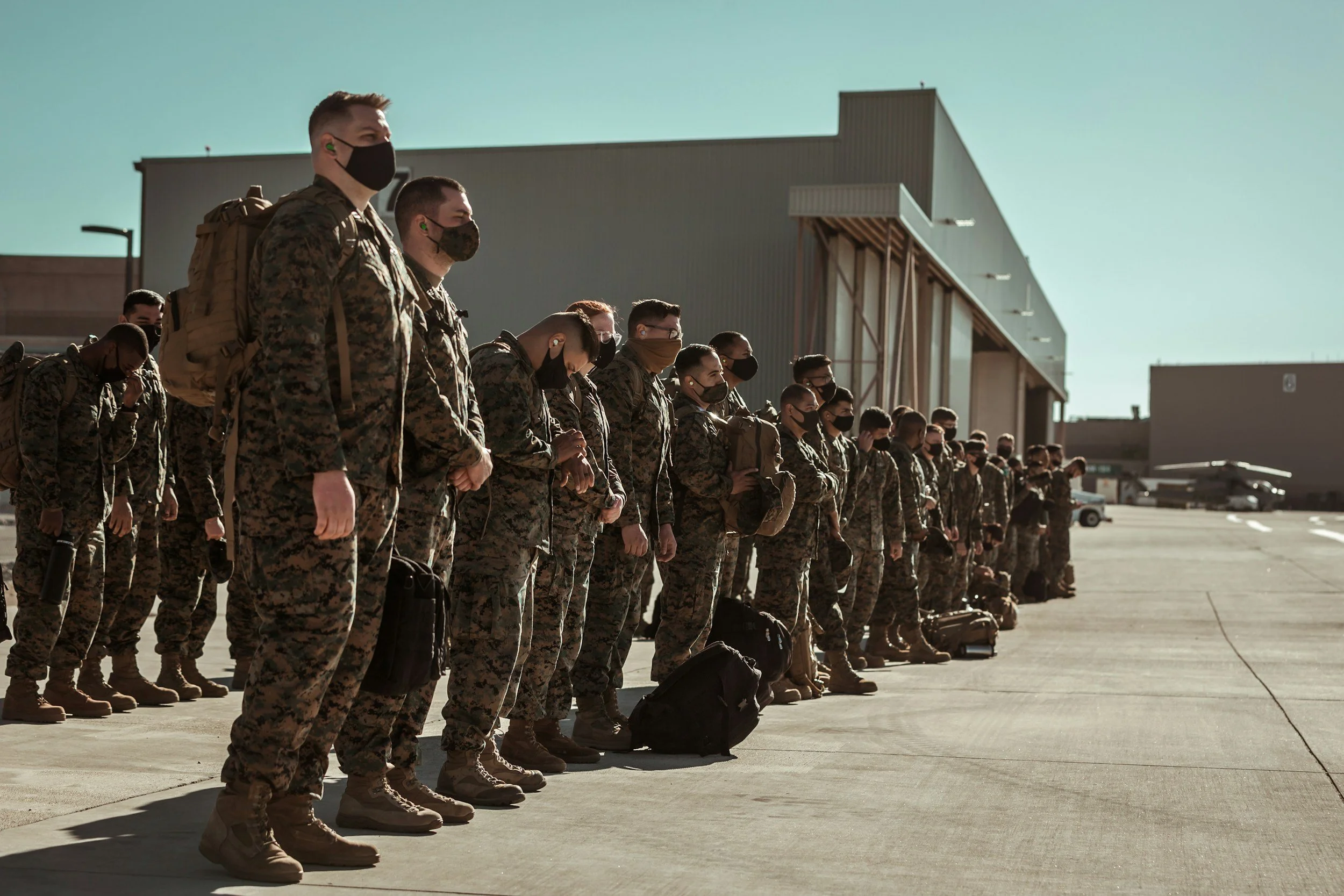
Respiratory infection is the most common illness in military populations and accounts for roughly a quarter to a third of all reported illness. Recruits in basic training are worst affected: open bay barracks of twenty or more, arriving from across the country, in the weeks when they are most run down. Acute respiratory disease has driven outbreaks at training establishments for decades, which is why several nations vaccinate recruits against adenovirus, and in the years when that vaccine was unavailable in the United States, illness rates at training sites rose sharply and did not fall again until it was reintroduced. Adenovirus itself is non-enveloped and persists on surfaces, so it spreads by both routes a Far-UVC unit treats.
At sea the problem is the same with no way off. Navy and Marine Corps units have logged dozens of infectious outbreaks in a five year period, flu being the most common; one port visit has been enough to put well over a hundred sailors on the sick list. On deployed operations, respiratory illness rates among personnel in Iraq and Afghanistan were estimated at around 15% a month, and in a seventh to a third of those cases the person's performance was affected. Troops billeted in tightly built, air conditioned accommodation fare worse than those who are not.
None of this is exotic. It is flu, adenovirus, norovirus and the common cold, in rooms with too many people and not enough air, and it costs a force watch-keepers, aircrew, training days and operational tempo.
Where it fits
Naval vessels. Mess decks, galleys, the bridge, operations rooms, accommodation alleyways, the sick bay and the gym. A warship has the ventilation it was designed with and no more, and in citadel conditions it recirculates. Far-UVC works independently of the air handling, so it keeps going when the ship is buttoned up, and it keeps going whilst the compartment is crewed. For the commercial equivalent of this reasoning see cruise ships, where the ProTech 2 is already in service.
Field hospitals and role 2 and role 3 facilities. A deployed medical facility has none of the air handling of a permanent hospital: it is a tent or a container with a ventilation unit, treating wounded and sick people side by side, often in dusty or humid conditions, often with limited water for cleaning. The clinical evidence for 222nm comes from exactly this sort of setting at home, and the published work on 222nm in occupied clinical areas, on surgical site contamination and on wound care in intensive care is the most directly relevant body of evidence we have, see Clinics and care.
Barracks and accommodation. Open bay sleeping accommodation, ablutions, mess halls, lecture theatres and recreation rooms. This is where an outbreak at a training establishment starts and where it can be slowed. The twelve care homes study is the nearest published analogue: fit units in the common areas and the sleeping accommodation and fewer people need treating.
Transit areas. Air terminals, APODs, ferry lounges, transit accommodation, troop decks and holding areas. These are the rooms where a unit from one theatre breathes the same air as a unit heading to another, and they are usually the worst ventilated buildings on the estate.
Command and control spaces. Operations rooms, joint headquarters and watch floors, where a small number of specialists who cannot easily be replaced work shoulder to shoulder for twelve hours at a time.
A continuous layer against biological agents
Protection against a deliberate biological attack is built in layers: detection, physical protection and filtration, medical countermeasures, decontamination, and the discipline that ties them together. Far-UVC does not replace any of them. It is not a detector, it is not collective protection, and it is not a decontamination system for a contaminated area. What it adds is a layer none of the others provide: a continuous reduction of biological material in the air and on the exposed surfaces of an occupied space, running all the time, with no warning required and nothing for anyone to switch on.
That matters because the layers that do the heavy lifting are reactive. Filtration and collective protection work once the system is sealed and running. Medical countermeasures work after the event and only for the agents they cover. Detection has to detect something first. A continuously running Far-UVC layer is already working during the period that matters most, which is the time between release and recognition, when people are still breathing normally in a room.
What the evidence supports. 222nm inactivates a wide range of bacteria and viruses, including hardy organisms. Studies for spacecraft and cleanroom work, where the standard is planetary protection rather than human comfort, found 222nm effective against UV-resistant vegetative bacteria and against bacterial spores on a range of surfaces, with a 90% reduction of the toughest tested spores in the region of 7 to 17 mJ/cm² depending on species and surface. Viruses and ordinary bacteria need far less, typically 1 to 3 mJ/cm².
What it does not do, and we would rather say so. Spores need substantially more dose than viruses, so a unit running at the occupied-room rate reduces a spore load over hours rather than minutes; a room can be run at a much higher dose when it is empty, which is where the occupancy sensing earns its place. The light only treats what it reaches, so shadowed surfaces, equipment interiors and anything under cover are untreated. A heavy particulate or organic load shields organisms underneath it. And no light-based system is a substitute for respiratory protection, collective protection or detection where a credible threat exists. Anyone who tells you their lamp defeats a biological attack on its own is selling something.
Deterrence by denial. The military logic of a persistent protective layer is that it reduces the expected effect of an attack, and a weapon with a reduced expected effect is a less attractive one to use. That is deterrence by denial rather than by threat of response, and it is the same reasoning that justifies filtration, vaccination and hardened shelter.
Dual benefit. The same units that provide that layer are, every single day when nothing is happening, reducing the flu, the adenovirus and the norovirus that are taking people off duty anyway. The peacetime case stands on its own, which is what makes the biological defence case affordable.
Fitting it to a defence estate
Flush ceiling mounted, 22cm across and 10cm deep, aluminium body, supplied with a fire dome, so it goes into a marine ceiling, a barrack block corridor or a modular medical facility. 100 to 240 volts, 50 or 60 Hz, 20W. One unit covers about 20 square metres under a 3m ceiling.
FAQ
Is it safe for personnel living under it continuously?
Yes, within the published exposure limits, which the unit is designed to hold. Workers under 222nm lamps for a year showed no effect on their eyes, and mice exposed daily for 66 weeks, most of their lives, developed no skin cancer or other skin changes. 222nm cannot reach the living cells of the skin or get through the tear film of the eye. Safety.
Does it work against the things that actually take people off duty?
That is its main job. Flu, coronaviruses, norovirus and common bacteria are all well covered by the published studies. The studies.
Does it work on spores?
Yes, at higher doses than viruses need. Published work on spacecraft and cleanroom surfaces found 222nm effective against resistant spores, with a 90% reduction in the region of 7 to 17 mJ/cm². In an occupied room at the human exposure limit that is a matter of hours; in an empty room the unit can run much harder.
Can it be used in a CBRN posture?
It is a complement to collective protection and filtration, not a replacement. In citadel or sealed conditions it keeps working on the air inside the protected space, which is where people have taken their masks off.
Does it interfere with ship or aircraft systems?
It is a certified light fitting with a small controller, it has been tested to CE and UKCA standards and will not interfere with other systems.
Can it survive a deployed environment?
The standard unit is IP20, which suits an interior but not an exposed environment.
What happens to the data?
Each unit logs dose and occupancy. Where a customer requires it, the system can run entirely on a closed network with no external connection. The systems have encrypted certificates and can also be run offline
Do personnel have to do anything?
No. It runs by itself, with sensors that raise the dose when a space empties and hold it within limits when it is occupied. There is nothing to issue, nothing to wear and nothing to remember.
Is it export controlled?
No
References
Buonanno M, Kleiman NJ, Welch D, et al. 222 nm far-UVC light markedly reduces the level of infectious airborne virus in an occupied room. Scientific Reports, 2024. https://www.nature.com/articles/s41598-024-57441-z (free full text: https://pmc.ncbi.nlm.nih.gov/articles/PMC10954628/)
Welch D, Buonanno M, Tang Z, et al. 222 nm far-UVC to inactivate airborne bacteria in an occupied dental clinic. Journal of Hospital Infection, 2025. https://doi.org/10.1016/j.jhin.2025.11.015 - Buonanno M, Welch D, Shuryak I, Brenner DJ. Far-UVC light (222 nm) efficiently and safely inactivates airborne human coronaviruses. Scientific Reports, 2020. https://www.nature.com/articles/s41598-020-67211-2
Welch D, Buonanno M, Grilj V, et al. Far-UVC light: a new tool to control the spread of airborne-mediated microbial diseases. Scientific Reports, 2018. https://www.nature.com/articles/s41598-018-21058-w
Eadie E, Hiwar W, Fletcher L, et al. Far-UVC (222 nm) efficiently inactivates an airborne pathogen in a room-sized chamber. Scientific Reports, 2022. https://www.nature.com/articles/s41598-022-08462-z
Petersen C, Urbano J, Hinzer A, et al. Susceptibility of microbes to far-UVC light (222 nm) on spacecraft and cleanroom surfaces. Microbiology Spectrum, 2025. https://doi.org/10.1128/spectrum.02276-25 (free full text: https://www.ncbi.nlm.nih.gov/pmc/articles/PMC12671110/)
Buonanno M, Randers-Pehrson G, Bigelow AW, et al. 207-nm UV light: a promising tool for safe low-cost reduction of surgical site infections. PLoS One, 2013. https://doi.org/10.1371/journal.pone.0076968
Mogensen EH, Jensen JT, Skaarup SH, et al. Ceiling-mounted far-UVC fixtures reduce the surface bioburden in occupied clinical areas. Infection Control & Hospital Epidemiology, 2025;46:647–649. https://doi.org/10.1017/ice.2025.62 (free full text: https://www.ncbi.nlm.nih.gov/pmc/articles/PMC12169949/)
Kristensen MA, Mogensen EH, Nielsen SY, Holm CK. The potential effectiveness of far-UVC (222 nm) in preventing infections in long-term care facilities. Antimicrobial Stewardship & Healthcare Epidemiology, 2026. https://doi.org/10.1017/ash.2026.10425 - Tsai YT, Li RT, Lai HJ, Chang WP. Application of 222-nm ultraviolet radiation C device to heal wounds and control infections in pressure injuries in intensive care unit patients: a randomized controlled trial. Intensive and Critical Care Nursing, 2025. https://doi.org/10.1016/j.iccn.2025.104162
Sugihara K, Kaidzu S, Sasaki M, et al. One-year ocular safety observation of workers… in the room irradiated with 222-nm far ultraviolet-C lamps. Photochemistry and Photobiology, 2023;99:967–974. https://doi.org/10.1111/php.13710
Welch D, Kleiman NJ, Arden PC, et al. No evidence of induced skin cancer or other skin abnormalities after long-term (66 week) chronic exposure to 222-nm far-UVC radiation. Photochemistry and Photobiology, 2023;99:168–175. https://doi.org/10.1111/php.13656
Sanchez JL, Cooper MJ, Myers CA, et al. Respiratory infections in the U.S. military: recent experience and control. Clinical Microbiology Reviews, 2015;28:743–800. https://pmc.ncbi.nlm.nih.gov/articles/PMC4475643/
Radin JM, Hawksworth AW, Blair PJ, et al. Dramatic decline of respiratory illness among US military recruits after the renewed use of adenovirus vaccines. Clinical Infectious Diseases, 2014;59(7):962–968. https://researchexperts.utmb.edu/en/publications/dramatic-decline-of-respiratory-illness-among-us-military-recruit/
Clemmons NS, McCormic ZD, Gaydos JC, et al. Acute respiratory disease in US Army trainees 3 years after reintroduction of adenovirus vaccine. Emerging Infectious Diseases, 2017;23:95–98. https://wwwnc.cdc.gov/eid/article/23/1/16-1297_article (free full text: https://pmc.ncbi.nlm.nih.gov/articles/PMC5176242/)
Updated: October 2026